

Listen to the audioblog (1819 words)
The Wild Heart of Iberia
The first shiver of thunder rumbled across the distant peaks as dawn unfurled in strokes of gold and violet over the Ebro Valley. Bravío lifted his head, nostrils flaring, catching the scent of rain before the first drops touched the earth. The wind carried the warning—sharp, electric, alive. A storm was coming.
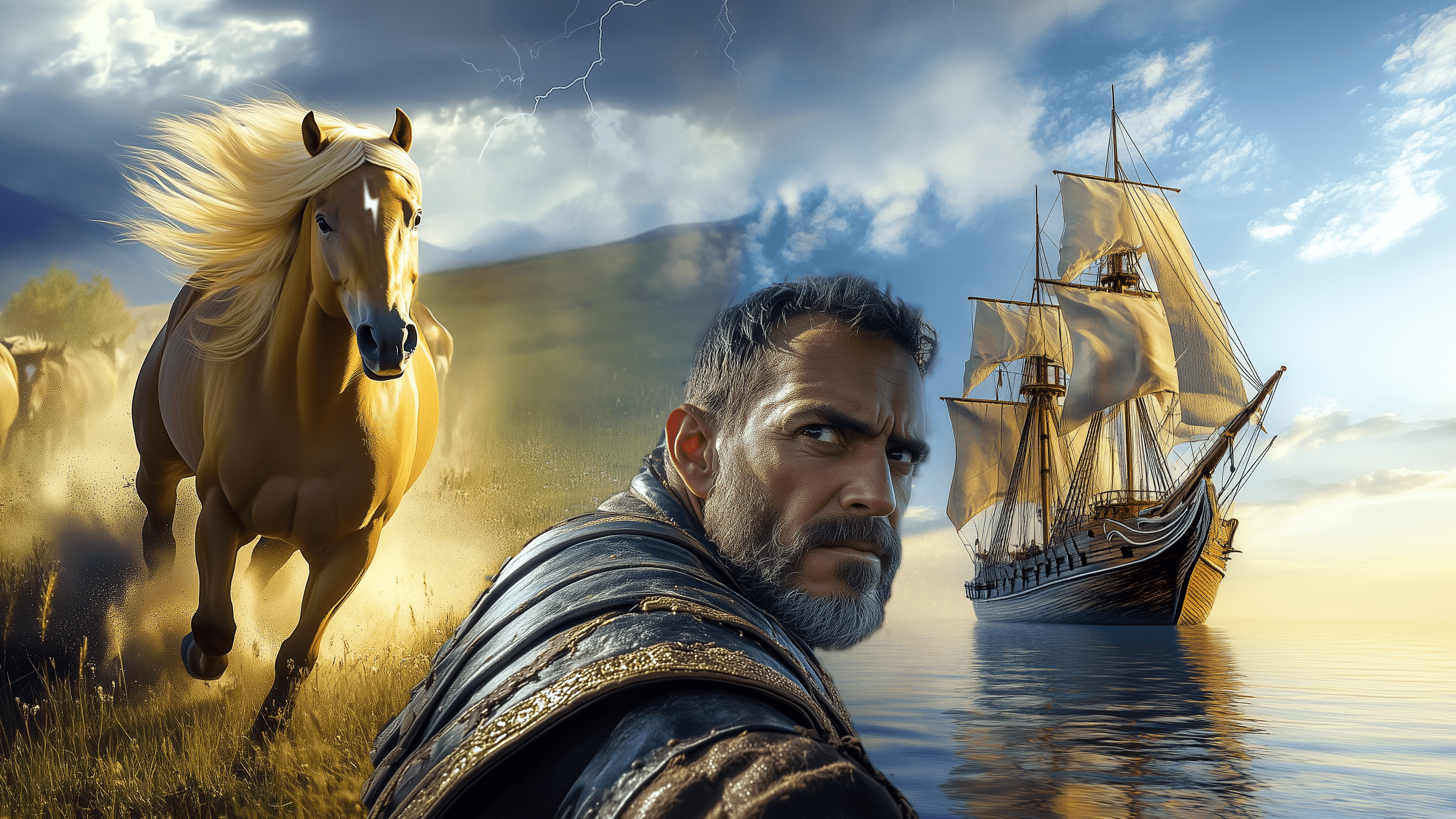
He stood atop a low rise, scanning the land below, his muscles taut beneath his bronze coat, his blonde mane cascading down his flank, the white blaze on his forehead shaped like a lightning bolt from the sky. His herd, scattered along the valley floor, grazed in peaceful oblivion, their tails flicking lazily at flies. But Bravío felt the shift in the air, the way the wind curled through the grass, whispering urgency. His world was one of instinct, of survival, and this—this was danger.
With a sharp, commanding snort, he lunged forward, his hooves pounding against the dampened earth. The elder mares lifted their heads as he approached, their ears swiveling toward him. He circled them, cutting through the herd like a river through rock, his powerful presence undeniable. The elders knew what to do. Their duty was to gather and guide, while his was to drive and defend.

The mares whinnied and surged into motion, their bodies flowing as one. Yearlings hesitated, glancing at their mothers, then bolted to follow. The herd responded to order born of trust, a structure etched into their bones by generations.
The sky cracked open. A streak of silver lanced through the heavens, followed by a roar that sent shockwaves through the valley. Bravío’s heart hammered, but he did not waver. He rushed the stragglers, pushing them up the valley toward the safety of higher ground. Behind them, the wind howled, driving sheets of rain that blurred the landscape into a trembling mirage of motion and sound.
As the last foal cleared the river, Bravío turned, glancing down into the valley one last time—his kingdom, now drowning in shadow and storm. He had led them to safety. He had done his duty.

For now, the world still belonged to him.
The Storm of Men
The scent of men drifted through the valley before Bravío saw them. A foreign musk, laced with the smell of leather, sweat, and iron. Vaqueros—riders draped in wide-brimmed hats and flowing cloaks—moved like shadows among the boulders, eyes locked on the herd. They had come for him.
Bravío’s ears flicked back, his instincts screaming. He gathered the mares, pushing them toward the far side of the valley. But the men knew their prey well. They split apart, some driving the herd forward while others flanked from the sides, isolating him in a cruel game of control.
The first loop of rope snapped through the air, coiling around his neck. Bravío reared, his powerful legs kicking, nostrils flared in defiance. Another lasso caught his front leg, wrenching him off balance. The world tumbled, hooves striking air, the ground a blur of dust and pain. The men tightened their hold, muscles straining against his strength. He fought—harder than any horse they had caught before. But flesh, no matter how strong, could not outlast the cold precision of men.
Days passed in a daze of struggle and exhaustion. They worked him ruthlessly, breaking his spirit bit by bit, forcing compliance with food, pain, and sheer will. He learned their commands, felt their hands press against his heaving sides, and the pull of a bridle forcing his head down in submission.

When they finally led him away from the valley, his hooves dragging against the earth, Bravío turned his head one last time. The Ebro river valley stretched behind him, the wind whispering through the grass, calling him back. But he would never return. His heart knew it before his mind did. He was leaving the only world he had ever known.
The journey to Seville was long. Through winding roads, across rolling hills and endless plains, Bravío marched with the Vaqueros, his body aching from the relentless pace. A week passed before they reached the bustling city, its scent thick with salt and trade and the smell of men. At the docks, among the cries of merchants and the creak of ships, a wily horse trader appraised him with a shrewd gaze. Coins exchanged hands. A new master. A new fate.

The Spanish Galleon loomed before him, its sails reaching toward the sky like skeletal fingers. Bravío balked, nostrils flaring, but the trader tugged the rope, forcing him forward. The wooden ramp groaned beneath his weight as he was led below deck, into the ship’s dark belly. The air was thick, suffocating, filled with the scent of sweat, seawater, and fear.
They bound his front legs with thick rope, tying him to an iron ring embedded in the floor. A sling hoisted his hind legs from the ground, suspending him in cruel limbo. Dozens of other horses surrounded him, some of his own herd’s mares, their bodies shifting uneasily, eyes rolling in fear, looking to him for protection.

Above, the sails filled with wind, and the ship groaned as it pulled away from the dock. The horizon swallowed Seville, and with it, any remnant of Bravío’s old life. He did not yet understand where they were going. Only that the land had vanished. And that the sea, deep and endless, had claimed him now.
Into the Abyss
The Galleon Caravel, flanked by ten other ships, sailed out of the Guadalquivir river from Seville and into the vast, merciless sea, setting course for the New World. The voyage stretched into weeks, the rolling of the waves becoming an unending rhythm of confinement and despair. The air in the hold grew thick, and Bravío’s muscles ached from his suspended torment.
Then came the storm.

A monstrous gale tore through the fleet, battering the ships with relentless fury. Lightning lacerated the heavens, illuminating the terrified faces of men scrambling to secure sails and cargo. Below deck, the horses screamed, thrown against the walls of their stalls as the ship pitched violently. Bravío fought against his restraints, his mind clawing for a way out, his instincts telling him to run, but there was no escape—only the suffocating dark, the howling winds, and the ceaseless, punishing waves.
When the storm finally passed, it left devastation in its wake. The fleet was scattered, sails torn, decks flooded. But the worst was yet to come.

The next morning, silence. No wind, no waves. The ships lay trapped in the oppressive heat of the doldrums—the Horse Latitudes. Days passed in agonizing heat and stillness. The water supply dwindled. The crew suffered, but the horses suffered more. They required too much. One by one, they were denied water. Their cries grew weaker.
Then the order came.
Bravío heard the strange, desperate cries of his kin being led above deck. Then the splash. Again. And again. Until finally, they came for him.

His heart pounded as they pulled him from the dark into the blinding sun. The air was fresh, but the endless water surrounding him was a terrifying abyss. He reared, fighting, but the lash of a whip and the brute force of men drove him forward. With one last crack, he leaped.
The water hit like stone. His body plunged deep, darkness swallowing him whole. He fought to rise, breaking the surface, gasping for air. Around him, other horses struggled, their cries lost in the expanse. There was no land. No salvation.

Bravío swam, but exhaustion crept in. As the fleet drifted into the distance and his kin sank into the deep, he ceased his struggle and accepted his fate. His mind drifted to the valley, to the wind in his mane, to running free with his herd, to the freedom that had once been his. His body, regal and proud, sank beneath the waves.
A month later, the fleet landed in Mexico. But Bravío was gone, lost to the abyss, a legend swallowed by the sea.
Return to Freedom
Decades passed, and the surviving horses, descendants of those who endured war and hardship, found their way back to wild grassy valleys. Some of the mares from Bravío’s herd, once enslaved by men, had broken free. Across battlefields and unforgiving landscapes, they had persevered, their spirits refusing to be tamed. And over the years, they moved north, following ancient instincts, drawn to a place they had never seen but somehow knew.
They reached the Great Plains—a land of endless horizons, where grasslands stretched beyond sight, and the sky was vast and eternal. Here, in this untouched wilderness, they found home. This was where their ancestors had evolved, where they had once roamed long before humans ever set foot on the land. It was as if they had returned to a forgotten past, to a freedom that had never truly been lost.
Generations passed, and the herd flourished, running alongside massive bison herds, drinking from clear rivers, and living as they were meant to. One day, among the shifting golden grasses, a mare—descended from Bravío’s bloodline—gave birth to a small colt. His coat gleamed in the sunlight, and on his forehead, a white blaze the shape of a small lightning bolt.
Bravío had been reborn. His legacy had endured.
As the young colt took his first unsteady steps, the wind whispered through the plains, carrying with it the echoes of his ancestors. He would know freedom, not as something lost, but as something reclaimed. And in this vast and boundless land, he would run once more.

Guide to the Horse Latitudes:
What are the Horse Latitudes?
The Horse Latitudes are regions of high pressure located around 30 degrees north and south of the equator, characterized by calm winds, hot temperatures, and dry conditions. Historically, these areas were notorious for trapping sailing ships in windless waters, often forcing sailors to conserve resources by throwing cargo—including horses—overboard. The name is believed to originate from these desperate measures taken during long voyages across the Atlantic.
How many horses were transported to the New World in the 16th century?
During the 16th century, thousands of horses were transported from Spain to the New World as part of the Spanish colonization efforts. While exact numbers are difficult to determine, historical estimates suggest that several thousand horses were shipped across the Atlantic, with many perishing during the journey.
Some key points:
- Hernán Cortés brought 16 horses to Mexico in 1519, marking the first significant introduction.
- By the late 1500s, Spanish expeditions had transported hundreds to thousands more horses to regions such as Mexico, the Caribbean, Central America, and South America.
- Horses were bred in colonial settlements, particularly in Mexico and the Caribbean, leading to their rapid expansion across the continent.
By the 17th century, wild horse populations, particularly in the Great Plains, had grown significantly, largely due to escaped or traded horses from Spanish settlements.
Why is there little wind in the Horse Latitudes?
The lack of wind in the Horse Latitudes is caused by the presence of high-pressure systems around 30 degrees north and south of the equator. This phenomenon occurs due to the following atmospheric processes:
- Descending Air – Warm air from the equator rises due to intense heating, then moves toward the poles. Around 30 degrees latitude, this air cools, becomes denser, and sinks, creating a stable high-pressure system.
- Weak Surface Winds – As the air descends, it spreads outward in both directions (toward the equator and the poles). This results in weak or inconsistent winds, leaving sailing ships stranded for long periods.
- Dry and Arid Conditions – The sinking air inhibits cloud formation and precipitation, contributing to the formation of many of the world’s major deserts, such as the Sahara, Mojave, and Australian Outback.
This windless region was dreaded by sailors during the Age of Exploration, as it often forced them to throw excess cargo—including horses—overboard to conserve drinking water.

What did European settlers do to native American tribes?
European settlers’ arrival in the Americas led to widespread displacement, exploitation, and devastation of Native American populations. Through colonization, they seized land, introduced diseases that decimated indigenous communities, suppressed cultures, and imposed systems of forced labor, all under the guise of expansion and religious conversion, fundamentally altering the lives and futures of Native peoples.
Ned Blackhawk, in his work “The Rediscovery of America: Native Peoples and the Unmaking of U.S. History,” emphasizes that the colonization of the Americas was marked by the systemic violence, displacement, and exploitation of Native peoples, facilitated by European technologies, animals like horses, and disease. He argues that this process was not merely a backdrop to American history but a central and ongoing force that reshaped indigenous societies and the continent’s political, economic, and cultural landscape.
What was role did horses play in this conquest?
Horses revolutionized transportation, warfare, and labor for European colonizers in the Americas, enabling conquest, territorial expansion, and the reshaping of indigenous societies.
How did horses change Native Americans?
Ned Blackhawk emphasizes that horses, introduced by European colonizers, transformed indigenous societies by revolutionizing transportation, hunting, and warfare, profoundly altering Native lifeways and power dynamics. He highlights that horses were also key tools of European conquest, enabling rapid territorial expansion and the establishment of colonial control over vast regions.
Watch the video:
References and further reading :
- Ladendorf, J. M. 2015. Spanish Horsemen and Horses in the New World. CreateSpace Independent Publishing Platform, 204 pp.
- Linnartz, L., R. Meissner & R. Lemoine (2023). Rewilding horses in Europe. Background and guidelines. Publication by Rewilding Europe, Nijmegen, The Netherlands.
- Luis, C. Bastos-Silveira, C., Cothran, E. G. and M. do Mat Oom. 2006. Iberian Origins of New World Horse Breeds. J. Heredity 97 (2), 107-113. https://doi.org/10.1093/jhered/esj020.
- Rewilding Europe
- Taylor, W. T. T. T. et al. 2023. Early dispersal of domestic horses into the Great Plains and northern Rockies. Science 379(6639):1316-1323. htps://doi: 10.1126/science.adc9691.
- Windmiler, J. M. 2024. The calm and variable inner life of the Atlantic intertropical convergence zone: the relationship between the doldrums and surface convergence. Geophysical Research Letters, 51, e204GL 109460. htps://doi: 10.1029/2024GL 109460.
One response to “Horse Latitudes: The Legend of Bravío”
polished! Scientists Successfully Clone Endangered Species 2025 supreme