

Behind the Songs is a series of short reflections on the worlds, ancient histories, and cosmology of my Songs of the Universe trilogy. In each post, I explore one idea—what it means within the story, how it connects to the larger journey, and how science, nature, philosophy, and imagination helped bring it to life.

Behind the Songs • Part 7
Living Lattices: When the Archive Is Alive
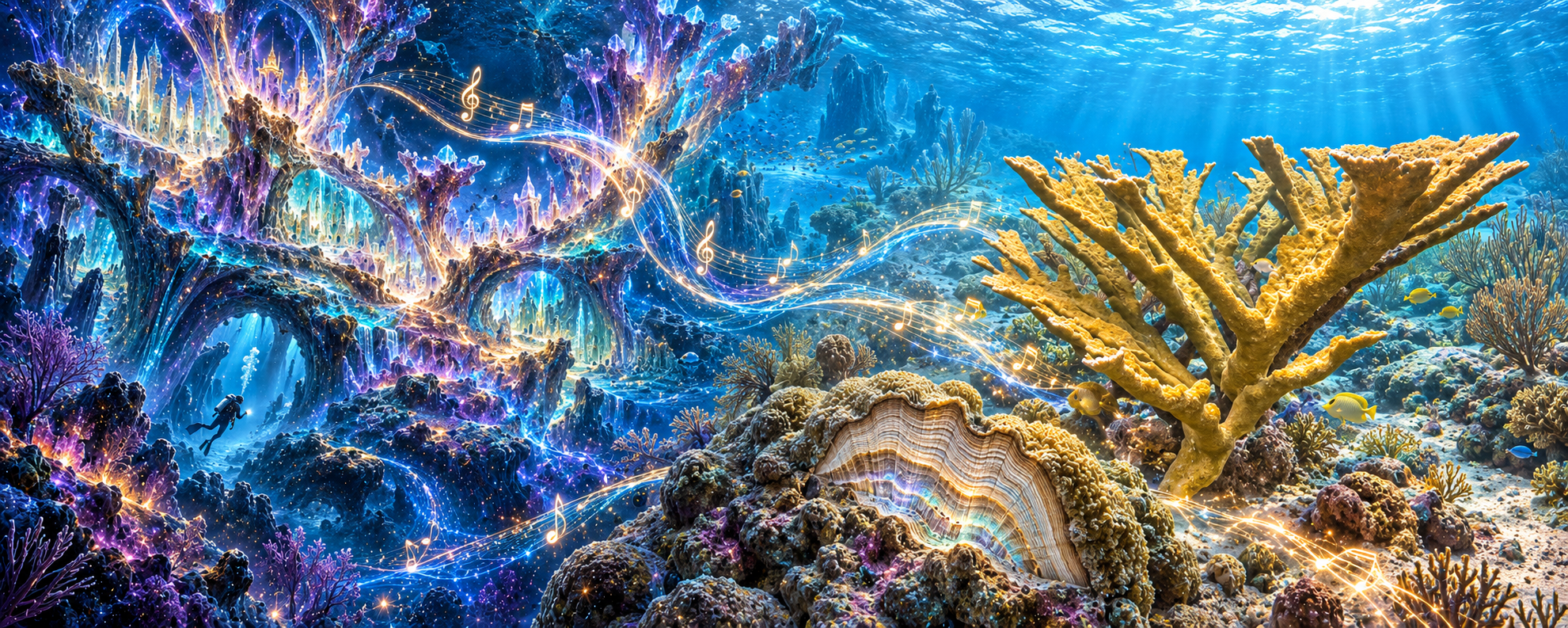
A reef carries its history in its body. New growth rests upon older skeletons, branches follow opportunities left by earlier lives, and the chemistry of the surrounding ocean becomes incorporated into growing structures. As a marine ecologist, I find something compelling in that continuity: the past remains physically present within a living community. When I imagined how ancient civilizations might preserve their experience, I returned to those underwater landscapes. What if an archive could grow—and remembering became part of staying alive?

In The Spiritual Engineers, the deep reefs of Lyridia, a surviving outpost of ancient Lyra, embody that possibility. Their coral-like structures accumulate mineral layers, biological growth, and patterns of resonance across immense stretches of time. Each generation grows within structures shaped by those that came before, carrying their history into new forms. Experience becomes woven into the reef’s physical organization: the branching of living stone, the relationships among crystalline layers, and the pathways through which vibration and light travel. Later lives can encounter that experience by entering into relationship with the structures that preserve it. As Rigel descends into those reefs, Lyra’s history becomes something he must learn how to receive.
I wanted that encounter to involve his whole awareness. Beneath his hand, vibration, color, memory, and feeling converge until the distinction between sensing and understanding begins to soften. The reef arranges meaning through those relationships, allowing a pattern to become recognizable before Rigel can put it into words. Its internal light brightens fractionally as he approaches, and the markings along its surface shift as though focusing. What first reaches him is age—a continuity so deep that his own life occupies barely a moment within it. He realizes that he has entered a place where the planet itself remembers, where individual experience has become part of a much longer living history.

What emerges includes the emotional shape of Lyra’s past: the hope that drew its people together, their belief that love could withstand the V’korr, and their difficulty recognizing the limits of their own understanding. Rigel encounters the distance between what they intended and what their choices made possible. Their failure becomes troublingly familiar because he recognizes some of those same impulses within himself—the wish to overcome suffering, the attraction of certainty, and the temptation to carry more than one life can hold. The reef gives him an opportunity to understand those impulses through consequences already lived by others. Remembering becomes part of adaptation: an ancient experience enters the present and changes the choices he is able to recognize. That was the possibility I wanted living lattices to hold—a past still capable of helping life grow differently.
Earth’s corals offered a foundation for imagining such archives. In tropical reef-building corals, growth bands and skeletal chemistry preserve evidence of the waters in which they formed. Scientists analyze chemical indicators, including oxygen isotopes and strontium-to-calcium ratios, to reconstruct past temperatures and changes associated with rainfall, evaporation, and salinity. Some records resolve conditions season by season, extending our view centuries beyond instrumental observations. These are high-resolution chemical archives—what I think of as paleoceanographic tape recorders, recording the ocean through growth.
Cold-water and deep-sea corals extend that possibility into environments far below sunlit reefs. Their skeletons can preserve evidence of changing ocean chemistry and circulation, helping researchers reconstruct how the deep ocean participated in earlier climate shifts. Some colonies also live astonishingly long lives: radiocarbon dating placed a Hawaiian black coral colony at approximately 4,265 years old. Individual polyps are replaced while the colony continues building its underlying skeleton, linking successive generations through a persistent physical structure. Longevity and the detail preserved vary among species, but together these corals reveal histories we could never observe within a human lifetime.

That history matters to human society because planning for climate change requires a longer perspective than our measurements alone provide. Coral records help establish past variability, reveal earlier ocean responses, and give scientists evidence against which to test their understanding of climate. Those baselines strengthen the knowledge used to anticipate change and inform mitigation and adaptation. Protecting a coral community therefore also preserves information that may help us understand our future. The living ecosystem and its accumulated history share the same vulnerability.
I carried that relationship further on Lyridia, where environmental memory also holds the experience of a civilization. Its reefs preserve Lyra’s story so that later generations can recognize patterns they might otherwise repeat. For Rigel, remembering becomes useful when it changes how he responds—when another world’s failure helps him question his own certainty and make room for a different choice. The archive remains alive because new experience continues to enter it. Its deepest value lies in helping life adapt while there is still time to change.


Leave a Reply