
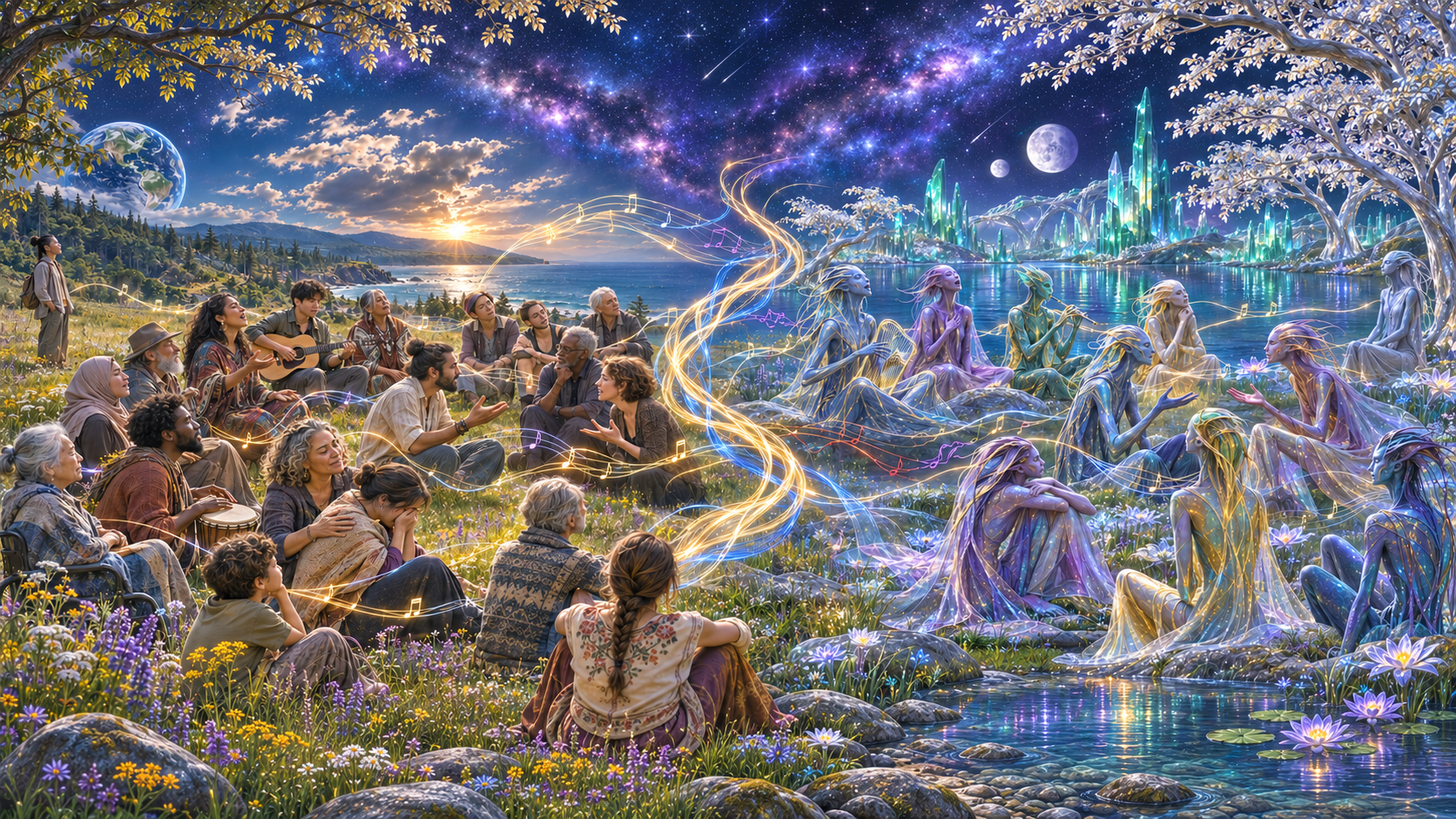

Behind the Songs is a series of short reflections on the worlds, ancient histories, and cosmology of my Songs of the Universe trilogy. In each post, I explore one idea—what it means within the story, how it connects to the larger journey, and how science, nature, philosophy, and imagination helped bring it to life.

Behind the Songs • Part 13
Why Lyra’s Song Failed
A moment of harmony can feel like a discovery that will change everything. People hear one another, differences become contributions, and something previously impossible begins to happen. I have felt versions of that experience in music, in relationships, and in people working together to protect a place they love. The difficult question comes afterward: what happens when someone disagrees, becomes afraid, or suffers in a way the others cannot understand?
That question became central to Lyra’s story.
Through Aelion and Elysia, the Lyr’een entered the First Song consciously. Their duet widened into the Kav’anara, a collective expression in which distinct beings participated without surrendering their individuality. Its beauty had real consequences as in moved through the Resonant Sea. When the V’korr descended, Lyra’s shared song disrupted them and drove them back. Love and cooperation accomplished something extraordinary.
Yet Lyra had learned to enter harmony faster than it had learned to sustain connection when harmony became difficult.
I wanted that vulnerability to grow from something recognizable. The Lyr’een had experienced a profound truth about belonging. Their mistake was believing that this discovery had prepared them for everything that might follow. Fear, grief, anger, and exhaustion still required attention. As those experiences emerged, the civilization increasingly struggled to make room for voices that could no longer join as easily as before.
As a tangible example, I thought about people working together in conservation. A shared love for a reef or forest can bring people into the same room without giving them the same understanding of what should happen next. They may disagree about methods, priorities, evidence, livelihoods, or how quickly change is possible. Those disagreements can be uncomfortable precisely because the purpose matters so much. Yet working through them can reveal consequences someone else has overlooked and make a proposed solution more acceptable, fair, and sustainable. Finding an answer is only part of the work.

People also need reasons to trust it, a meaningful role in shaping it, and the means to make the changes it requires. They do not have to agree on everything, but they need enough shared understanding to act together and enough trust to revise their approach when circumstances change.
For Lyra, that distinction mattered: joining the Song could express hope, but sustaining it required people to share responsibility for what happened next. But as the threat deepened, struggling to join the Song, of staying connected in agreement, began to feel like failing it. The Lyr’een who were frightened or overwhelmed could find themselves surrounded by beauty while feeling increasingly alone.
A loving family facing grief offers another way into that experience. Imagine a family accustomed to reassuring one another that everything will be all right. After a death, one person wants to speak about the loss repeatedly. Another needs quiet. Someone else stays busy with practical tasks because action makes the day bearable. Each may care deeply, yet misunderstand how the others are suffering.
If closeness depends on everyone appearing strong, grief becomes difficult to share honestly. A person may conceal distress to avoid burdening the family. Another may take responsibility for keeping everyone together, gradually exhausting themselves. Sustaining the relationship requires room for different responses and an acceptance that love does not give anyone an unlimited capacity to carry pain.
That tension shaped Aelion and Elysia.

As the Kav’anara faltered, Aelion tried to hold its pattern more tightly, preserving the continuity that had brought others hope. Elysia opened herself further, taking more grief and fracture into herself. Both acted from love. Yet their responses reduced the space in which others could remain present with unresolved feelings. Too much became dependent on Aelion’s steadiness and Elysia’s willingness to absorb what hurt and they eventually faltered
Lyra needed ways to share those burdens across its people. Instead, it increasingly relied on two beings to remain whole for everyone else. For the Kav’anara to endure, the Lyr’een needed to carry it through their own relationships: listening through disagreement, sharing grief, and finding their way back to one another when fear interrupted the Song. Its continuity depended on those countless exchanges, including moments when Aelion and Elysia could offer no guidance.

That required Aelion and Elysia to release what they had helped awaken—to trust others to carry it differently, change its expression, and discover possibilities they themselves could not foresee. Letting go would have meant accepting that the Song could continue beyond their ability to hold it together.
But as danger grew, they assumed more responsibility, and Lyra leaned more heavily upon them. The Kav’anara faltered because the relationship that had opened it to everyone remained the relationship on which too much depended. What began between two beings needed to become a living practice among many, capable of sustaining even its first singers when they faltered.
Beneath the Kav’anara is a metaphorical question about how we live together: can we remain connected without requiring everyone to experience life in the same way? Singing gave me a way to explore that possibility. Each voice enters with its own history, limitations, and capacities. Some carry grief, others hope; some need to be heard, while others need time before they can answer. Making music together requires attention to those differences. A shared song develops through the adjustments people make for one another, including the space they leave for what they do not yet understand.
That is also the work of love, family, and community. We cannot sustain belonging by asking everyone to remain agreeable, strong, or constantly available. Someone may need to disagree, establish a boundary, or step away without losing their place among us. Holding and opening give those needs a cosmic expression: enough continuity to make a relationship trustworthy, and enough freedom for the people within it to change. The Kav’anara becomes sustainable when its participants learn to practice both, especially when connection feels difficult.

Lyra discovered the extraordinary power of joining together, but too much of its Song remained dependent on Aelion and Elysia. Others could participate in the harmony they sustained without fully learning how to renew it among themselves. Their love became a burden when they felt responsible for keeping everyone connected. Releasing the Song required trusting others to alter it, struggle with it, and carry it through experiences its first singers could never anticipate. It also required allowing those first singers to become people who could receive support, rather than always provide it.
This is why Earth’s participation matters so deeply in the The Spiritual Engineers. When Rigel and Merope help people share the Song without depending on their continued participation, the relationship has become something Earth’s people can sustain through one another. The Song continues because people listen, answer, make room, and choose connection again through their differences. Rigel and Merope’s contribution endures in those choices, even when their voices are absent. What began as an invitation becomes a shared capacity—and the music can keep changing because it belongs to everyone who helps carry it.
For Lyra, inviting everyone into the Song was only a beginning. People also needed the ability to change it—to bring forward an experience that interrupted the prevailing understanding. Humility meant accepting that someone struggling at the edges might perceive a problem those at the center could not. Diversity of perception needed to be honored.
The V’korr exploited the fractures that grew where these conversations ended. Fear went unspoken. Grief became isolation. Certainty made it harder to recognize when an act of care had begun causing harm. Lyra’s earlier success offered little protection against truths it could no longer bear to hear.
I did not imagine its fall as proof that love was inadequate or cooperation naïve. Their power had already been demonstrated. What remained unfinished was the work of living by them through change.
That is the warning Lyra carries into the later story with Merope and Rigel. A relationship needs enough trust for disagreement, enough generosity for boundaries, and enough humility to recognize exhaustion. The Song must leave room for someone to falter—and for the others to listen before asking them to sing again.




Leave a Reply