

Behind the Songs is a series of short reflections on the worlds, ancient histories, and cosmology of my Songs of the Universe trilogy. In each post, I explore one idea—what it means within the story, how it connects to the larger journey, and how science, nature, philosophy, and imagination helped bring it to life.

Behind the Songs • Part 8
Starwhales: Currents of Ancient Memory
A whale at the surface reveals remarkably little of itself. A breath, an arching back, perhaps a lifted fluke—and then an immense life disappears into water. Below the surface, however, its presence can become astonishingly rich: songs of incredible beauty echo through the water, rising and falling with an otherworldly quality that makes the ocean feel vast and inhabited in ways we rarely perceive from above. For me, that encounter holds a particular kind of wonder: something can remain hidden from sight while its voice fills the space around us. We hear an expression of a life whose experience we can only begin to imagine. When I imagined beings moving through the universe’s deeper currents, whales gave me a way to approach their scale without making them entirely familiar.

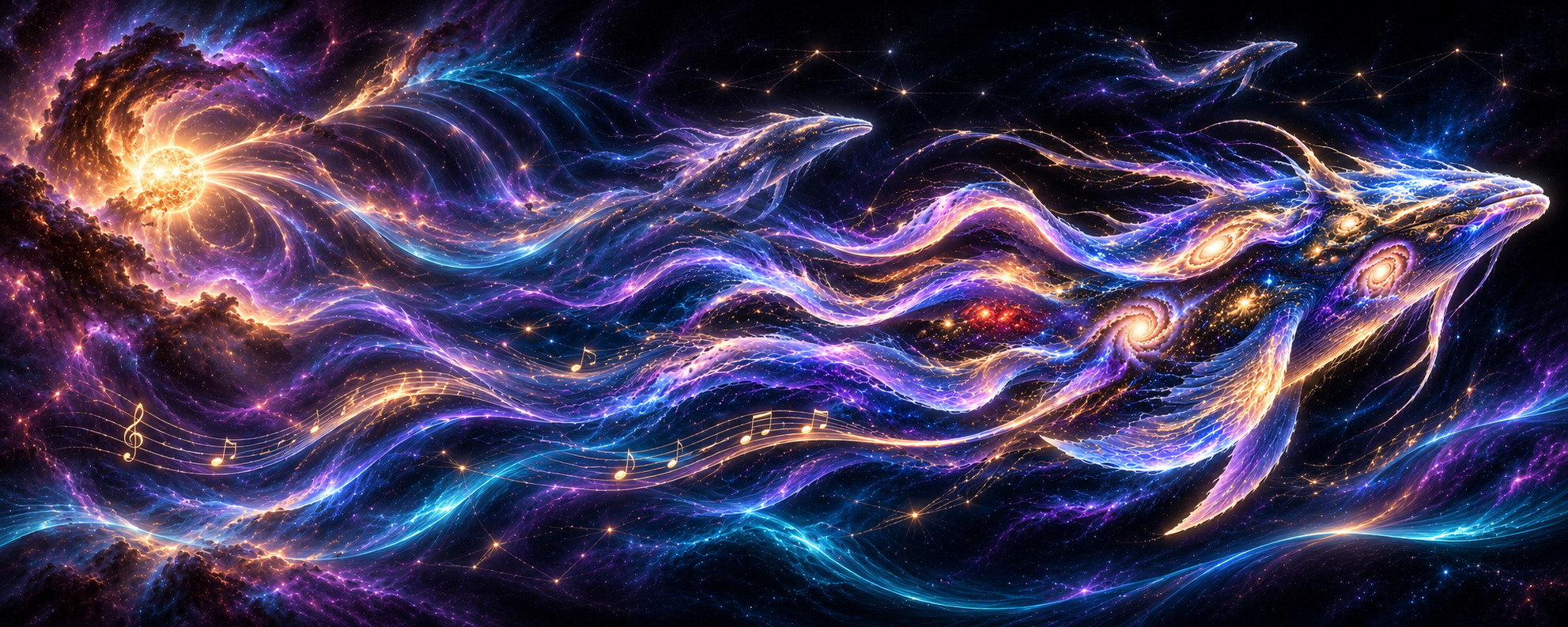
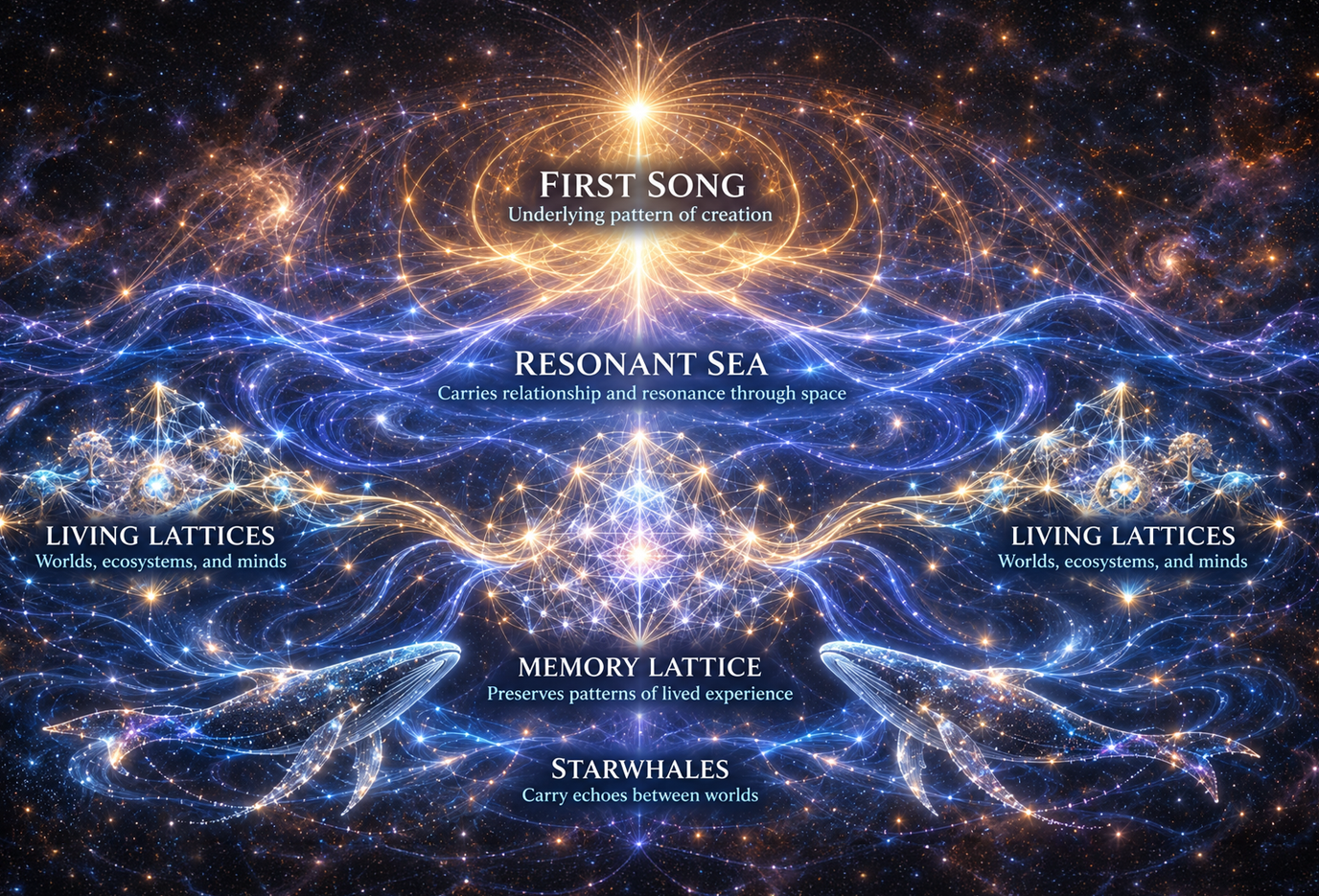
The Starwhales learned the currents and tides of the Resonant Sea before most civilizations knew they existed. I imagined their beginnings as faint disturbances within the immense clouds of dust, gas, and plasma between stars. Stellar winds stirred that material, while gravitational waves passed through it. Within the trilogy’s cosmology, these movements also met the deeper currents of accumulated memory flowing through the Memory Lattice. Some patterns endured, gradually acquiring the capacity to sense and respond. Across eons, they became vast migratory intelligences, their diffuse substance interwoven with energy and experience. They follow the Sea’s currents and tides, their forms holding fields in which stars seem to kindle, fade, and return. Some observers perceive slow-moving mists that bend starlight into arcs; others see constellations drifting out of alignment and returning.
In the trilogy, Merope perceives them as whales because her awareness understands the unfamiliar through water, breath, weight, and shared depth. That form gives her a relationship with something otherwise too vast to comprehend. We do something similar whenever we describe an unfamiliar experience through one we already know: a current of thought, a wave of grief, a voice in the darkness. Such comparisons help us recognize something while leaving much unexplained. Merope’s Starwhales are the closest shape her consciousness can hold without losing its footing in what they carry.
Their migrations connect them to the Resonant Sea, the movement through which accumulated experience becomes perceptible within the Lattice. They carry resonance as oceans carry pressure, brushing enduring patterns with their passage and sustaining their continuity across galaxies.
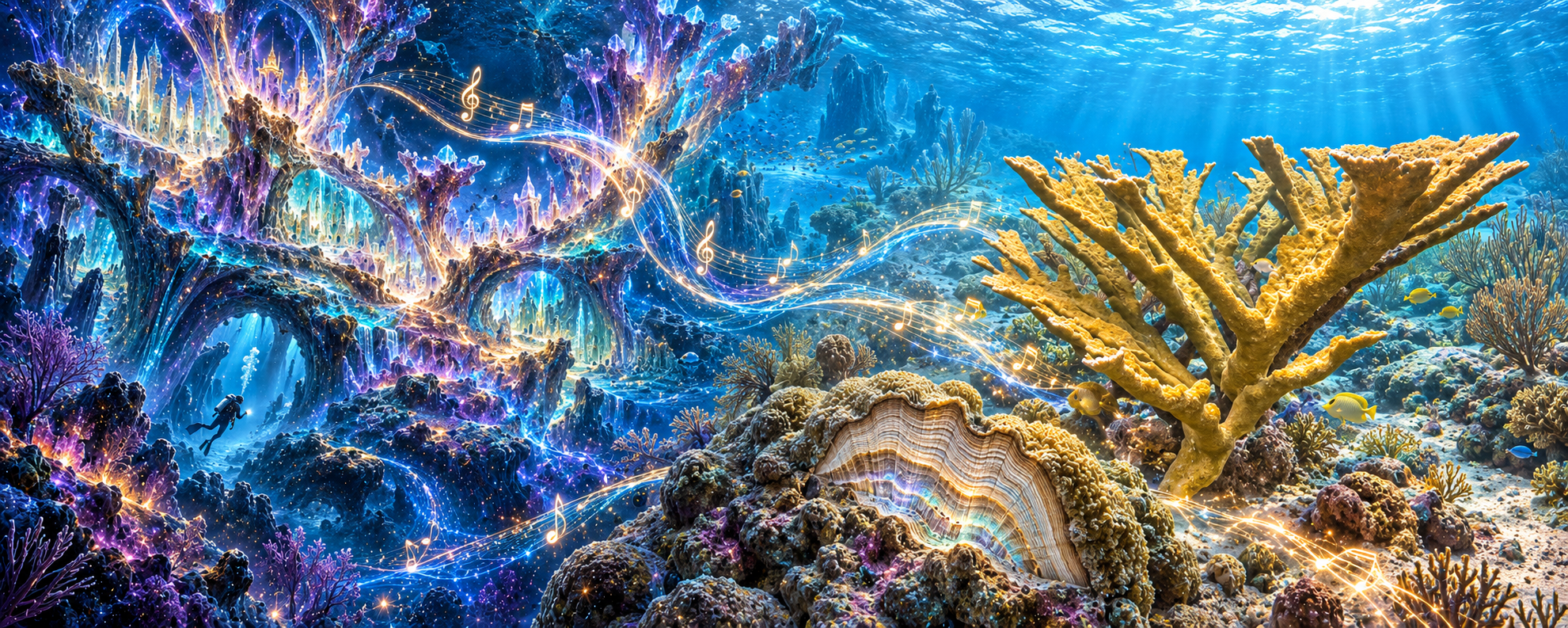
Some civilizations gradually learned to hear them. Within their passing, listeners sensed fragments of song and stronger currents in the Resonant Sea—patterns that offered orientation without determining a destination. The ancient planet of Lyra heard those possibilities in echos of the Elder Voices’ First Song and consciously entered the primordial harmony beneath them. Later, Earth’s cetaceans gave that deeper Song an ocean-born expression, carried forward through the Nesoi into Thalassa’s living seas. Sage’s encounter with their voices (“The Song Awakens”) opened a human relationship with something already unfolding across immense distances, beginning the cascade of events that carries the trilogy toward Earth.

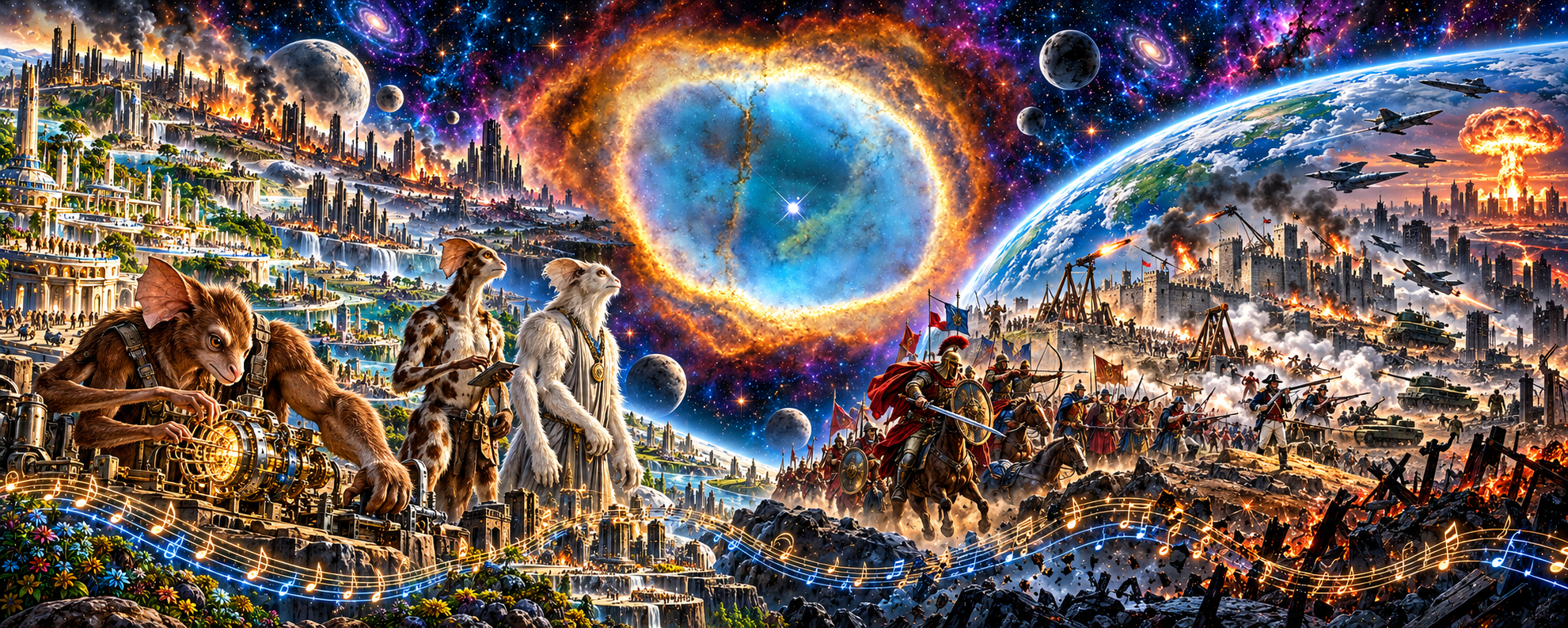
My goal throughout the books was to give the universe a depth and richness that extended beyond the events my characters could witness. Tolkien’s “impression of depth” offered an inspiration: the sense that an immediate story unfolds against ancient histories, surviving fragments, and losses whose full meaning can no longer be recovered. I wanted readers to feel that the songs they encountered had traveled through lives and worlds far older than the people hearing them now, back to the dawn of the universe.
Lyra’s ancient song grew from that desire, its interrupted phrases carried forward through the Lattice, the Starwhales, and the voices of later beings. Each encounter reveals something while leaving a larger history partly obscured. For me, that incompleteness makes the universe feel alive with rich layers of inheritance, giving Sage, Rigel, and Merope relationships with a past they must gradually learn to hear and understand.
Yet continuity remains vulnerable. The Nesoi elders of Shadowhaven etched shadows of Lyra’s memory into stone, preserving fragments of an experience whose full coherence was dangerous to approach. The Starwhales sustained patterns that remembrance had kept from disappearing, although the song itself had become interrupted and scattered. I wanted those echoes to require participation. Hearing the past would offer an encounter, leaving the listener responsible for what followed.

Merope hears something especially intimate within that vastness: a remembered interval, a relationship between voices that feels familiar before she can explain why. It carries a responsibility belonging to no species alone. Lyra’s song reaches her as an impossible recognition, something she has no ordinary reason—or right—to remember. And yet she does. Through her, I wanted cosmic wonder to become personal: the moment when something beyond understanding touches a life closely enough to ask for an answer.

Leave a Reply