
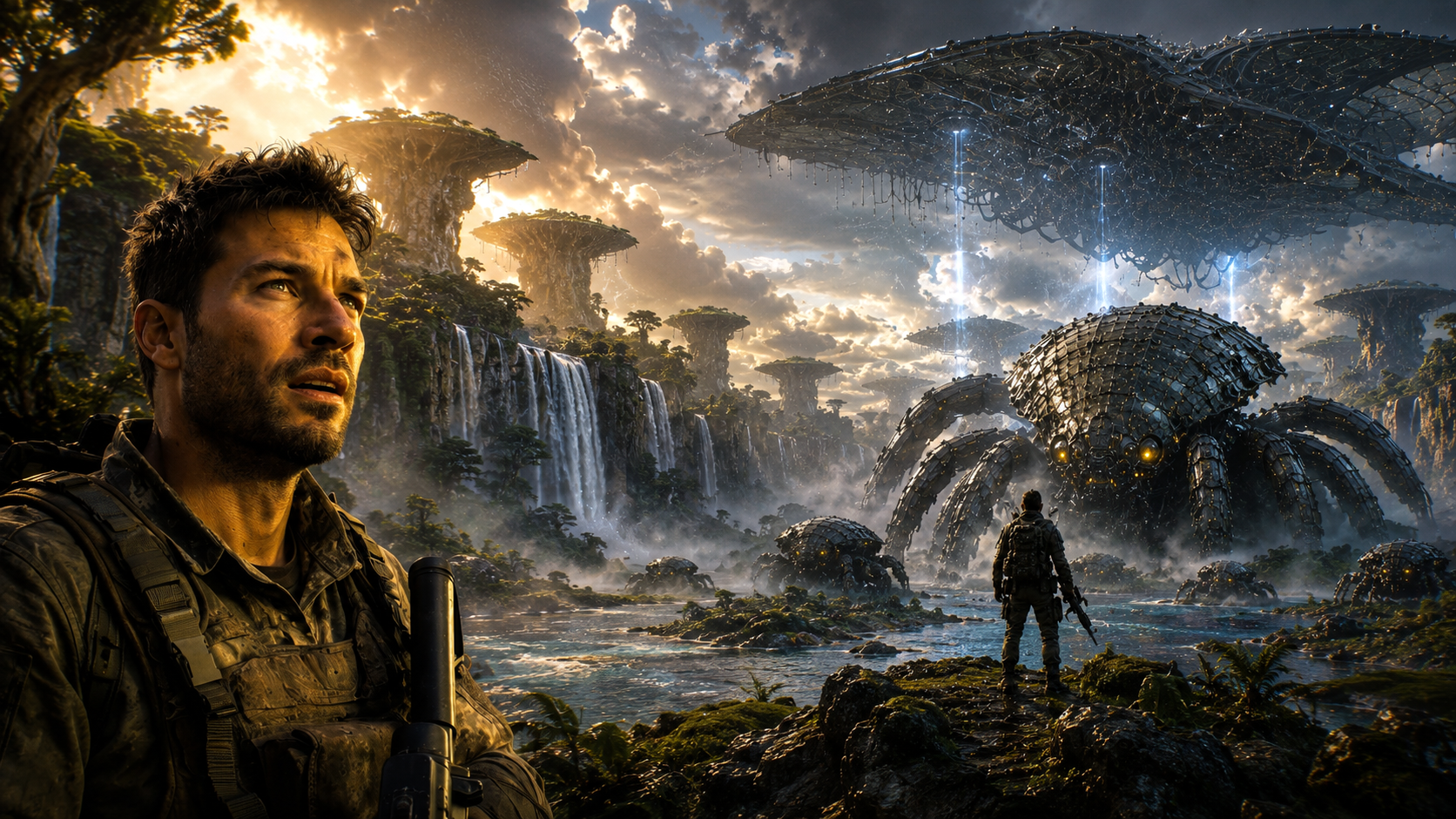

A broken soldier. A living planet.
A journey that reveals why nature remains essential to the human soul.
A Soldier Who Had Lost Everything
Earth did not die in a single apocalypse. It died slowly, exhausted by centuries of war, environmental collapse, and a civilization that forgot it was part of the living world. Cities expanded while forests disappeared. Technology advanced while wisdom lagged behind. Humanity reached for the stars without first learning to care for the planet that had given it life.

Kornak: Machine World begins at the end of that long decline through the eyes of Kael Ash, a soldier who has survived everything, yet lost every reason to keep living. Decades of warfare have stripped away everyone he loved. His wife and son are gone. Governments betrayed the very people they claimed to protect. His body has been rebuilt with military cybernetics until flesh and machine have become nearly indistinguishable. The soldier survives, but the man beneath him has quietly disappeared.
When Kael arrives on the distant world of Danu, he is not searching for redemption. He has no grand mission to save humanity. He simply wants the fighting to end. Like a lone survivor dragging himself through an indifferent wilderness after losing everything, he continues moving forward because instinct refuses to let him stop. His journey is no longer driven by hope, only momentum.
Sometimes survival begins only after everything else has been lost.

Danu: A Planet That Doesn’t Care Whether You Live
Danu offers Kael no mercy. Hypercanes, storms so immense they dwarf terrestrial hurricanes, sweep across continents with catastrophic force. Meteor storms periodically ignite the atmosphere, showering entire regions with fire from the heavens. Towering fungal forests rise hundreds of meters into perpetual cloud cover, while rivers wider than Earth’s greatest waterways cut through landscapes teeming with organisms unlike anything evolution produced on our world. Colossal predators stalk the forest floor. Enormous gliders drift silently through the canopy. Every fallen organism is consumed within hours by armies of scavengers and decomposers that leave nothing to waste.

The planet feels almost impossibly alive. Every surface carries life. Every breath contains unfamiliar spores. Every sound hints at another organism hidden somewhere beyond sight. Danu is breathtaking, terrifying, and astonishingly beautiful all at once. It is a world where weakness rarely survives for long, yet its violence is never cruel. Storms do not destroy from anger. Predators do not hunt from hatred. Death is everywhere, but it serves life rather than opposing it.
For Kael, accustomed to battlefields where every threat comes from another human mind, this distinction is impossible to understand.
The First Lesson: Adapt or Perish
Kael initially approaches Danu the only way he knows how—with military discipline. Every unknown movement becomes a threat assessment. Every creature is mentally categorized by function: predator, scavenger, grazer, glider. Soldiers survive by simplifying complexity into tactical decisions, and Kael’s instincts remain shaped by decades of war.

But Danu refuses to become another battlefield. There is no enemy commander to defeat. No territory to conquer. No ideology to destroy. Every organism is simply trying to survive within an ecological system unimaginably older than humanity itself. Predators hunt because they must eat. Scavengers recycle the dead because nothing in nature is wasted. Storms destroy ancient forests, allowing new generations to emerge. Every species occupies its place within an intricate web shaped by adaptation rather than conquest.
Kael slowly realizes that while violence exists everywhere on Danu, malice does not. That difference changes everything.
Healing Begins When the War Ends Inside
The greatest danger Kael faces is not hidden beneath Danu’s towering canopy, it has traveled with him across the stars.
Long before military cybernetics replaced his limbs, war had already transformed his mind. Grief became anger. Anger hardened into hatred. Hatred became the lens through which he viewed the universe. Like countless veterans throughout history, he continued fighting battles that no longer existed because conflict had become the only way he understood life.
Danu begins healing him, not because it offers comfort, but because it offers perspective.

Each day demands patience rather than aggression. He learns the rhythms of hypercanes instead of resisting them. He studies migration routes rather than forcing his own path through the forest. He discovers that observation often accomplishes more than violence. Gradually, he stops seeing himself as separate from the ecosystem around him. He becomes another organism adapting to an unfamiliar world rather than a conqueror attempting to dominate it. The forest asks nothing except participation.
Watching ecosystems recover after devastating storms, seeing predators feed without cruelty, and witnessing countless forms of life flourishing through cooperation rather than control slowly dismantles the emotional armor Kael has carried for years. Nature teaches him something civilization had forgotten: life endures not because it conquers, but because it belongs.
The Planet Changes Him
As weeks become months, Kael’s relationship with Danu transforms. Survival becomes understanding. Understanding becomes respect. Respect slowly becomes stewardship.
The forests that once threatened his life begin sustaining it. The creatures he feared become teachers in adaptation. Even the storms cease feeling hostile. They become part of an ancient cycle of destruction and renewal that has shaped life on Danu for millions of years.

For the first time since losing his family, Kael begins caring again. Not because someone asked him to, or because duty demanded it. But because Danu reminded him that life itself was still worth protecting.
He came to die. He found something worth fighting for.
Enter the Kornak: The Return of Humanity’s Darkness
Only after Kael rediscovers hope does the true conflict begin.
The Kornak arrive not simply as alien invaders, but as the embodiment of everything that destroyed Earth. Their civilization abandoned living ecosystems generations ago. Nature became inefficient. Adaptation became obsolete. Machines replaced biology. Engineering replaced evolution. Control replaced coexistence. Expansion became survival itself.

The Kornak represent the inevitable destination of a civilization that severs every meaningful connection with the natural world. Their technology is extraordinary. Their efficiency is unmatched. Entire planets become resources to consume. Ecosystems become obstacles to remove. Every calculation favors greater production, greater expansion, greater control.
Yet something essential has disappeared. The tragedy of the Kornak is not that they became machines. It is that they forgot why life mattered in the first place.
Why Kael Chooses to Fight
At the beginning of Kornak: Machine World, Kael no longer fears death. By the end, he fears something far worse. He fears losing the world that restored his humanity.

His decision to confront the Kornak is not driven by revenge. It is not another military campaign fueled by patriotism or ideology. It is the first battle of his life fought entirely for love—for the forests that healed him, for the astonishing diversity of life flourishing on Danu, and for the possibility that humanity can still choose a different future.
He came to Danu ready to surrender. He leaves the forest willing to fight. That transformation is the heart of the novel.
A Tale of Two Worlds
Kornak: Machine World is the opening chapter of the larger Songs of the Universe series, and its central conflict extends far beyond one planet.
The Kornak represent one possible future for civilization: domination over nature, limitless expansion, technological perfection, and complete separation from the living systems that created us. Danu represents another: adaptation instead of domination, diversity instead of uniformity, resilience instead of control, and an understanding that every organism exists because of its relationships with countless others.

The conflict between these two worlds is not simply good versus evil. It asks a deeper question.
As humanity reaches the stars, what kind of civilization will we become? Will we carry the same habits that exhausted Earth? Or will we rediscover our place within the living universe?
Why This Story Matters Today
Although Kornak: Machine World unfolds on an alien planet, its questions are deeply rooted in our own world.
Today, millions of people spend their lives surrounded by concrete, traffic, screens, and artificial light while experiencing unprecedented levels of anxiety, loneliness, and emotional exhaustion. We often treat these as isolated psychological problems, yet they may also reflect something far older.

Human consciousness evolved within living ecosystems. Our ancestors developed beside rivers, beneath forests, along coastlines, and across grasslands alive with countless other species. Our nervous systems were shaped by changing seasons, birdsong, flowing water, storms, moonlight, and the endless rhythms of the natural world. Those relationships were not recreation. They were existence.
When those connections are severed, something essential is diminished. When they are restored, healing often begins.
The Healing Power of Nature
One of the central ideas behind Kornak: Machine World is that wilderness is not a luxury, it is a biological and spiritual necessity.
Many of the themes woven throughout the novel grew from experiences I explored in essays such as Eight Experiences that Honor the Forces of the Ocean and The Call of Nature and the Renewal of the Nature Fast. Both examine how intentional immersion in the natural world can restore perspective, humility, gratitude, and emotional resilience.
Reconnecting with nature does not require an expedition into a remote wilderness. It can begin with something as simple as walking beneath trees without headphones, watching birds at sunrise, sitting quietly beside a river, exploring a tide pool, or listening to waves roll onto a beach. Hiking through old-growth forests, camping beneath the stars, paddling across open water, surfing, gardening, or practicing forest bathing all invite us to slow down enough to notice that we are participants in a living world rather than observers standing outside it.
A Nature Fast takes this idea even further by temporarily stepping away from digital distractions and immersing ourselves in wild places with intention. As our attention shifts from constant information to the rhythms of wind, water, birds, weather, and changing light, many people rediscover something increasingly rare in modern life: stillness.
Nature does not erase grief or trauma. But it reminds us that renewal has always been woven into the fabric of life itself.
The Wilderness Still Knows How to Heal Us
At its heart, Kornak: Machine World is not simply a science fiction adventure about alien worlds, towering forests, or terrifying predators. It is a story about surviving the darkness within ourselves. Kael’s greatest battle is never against the Kornak, it is against the hatred, grief, and despair that decades of war left behind.
The wilderness heals him not because it is gentle, but because it is honest. Nature neither judges nor rewards. It simply reveals that life endures through relationship rather than domination, through adaptation rather than conquest, and through belonging rather than isolation.
If readers finish Kornak: Machine World inspired not only by Kael’s journey but also by a desire to walk beneath towering trees, listen to birds, paddle across quiet water, or spend a night beneath the stars, then the novel has accomplished something beyond storytelling. It has reminded us that wilderness is not merely scenery or recreation. It is part of who we are.
Perhaps that is the greatest lesson Danu has to offer—not only to Kael Ash, but to all of us.
Protecting the Living Worlds That Sustain Us
The central message of the story extends beyond science fiction because the challenges facing Danu increasingly mirror those confronting Earth. Across the globe, the natural systems that shaped human evolution are under unprecedented pressure from a convergence of forces. Habitat destruction fragments once-continuous forests and grasslands into isolated remnants. Biodiversity declines as species disappear at rates unseen in human history. Climate change reshapes ecosystems faster than many organisms can adapt. Rivers are altered, coral reefs bleach, old-growth forests vanish, and expanding cities place growing distance between people and the living world that has always sustained them.
Equally concerning is the gradual loss of our connection to nature itself. Open spaces disappear beneath development. Access to wilderness becomes increasingly limited. National Parks and Monuments, marine reserves, and protected landscapes face mounting pressures from resource extraction, pollution, overcrowding, and shrinking budgets. For many people, especially younger generations, daily life unfolds almost entirely indoors, surrounded by concrete, screens, and artificial environments. As these opportunities for meaningful experiences in nature diminish, we risk losing not only biodiversity, but also the relationships that have shaped human culture, health, creativity, and spirituality since our earliest ancestors first walked beneath forest canopies and along wild rivers.

Protecting nature is therefore about far more than saving individual species or preserving beautiful places. Healthy ecosystems provide clean air, fresh water, fertile soils, climate stability, and countless other services upon which civilization depends.
Just as importantly, they nourish something less tangible but equally essential: our sense of wonder, belonging, humility, and perspective. They remind us that we are participants in a living community that extends far beyond ourselves.
That is ultimately the hope behind Kornak: Machine World. Although the novel imagines distant stars, alien ecosystems, and civilizations unlike our own, its heart remains firmly rooted here on Earth. It is a reminder that our future will depend not only on the technologies we invent, but also on whether we remember our place within the living world that gave rise to us.
May this story serve as a small reminder that the greatest wonders in the universe are not the machines we build, but the living worlds that make us who we are.
And may we always choose to protect them.
Watch the promotional video for Kornak: Machine World:
Further Reading
If the ideas behind Kornak: Machine World resonate with you, these additional resources provide accessible introductions to many of the concepts and experiences.
Blog Posts:
- The Call of Nature and the Renewal of the Nature Fast
- Eight Experiences that Honor the Forces of the Ocean
- The Last Song of Mother Earth and the Death of Coral Reefs
- Songs of the Trees
- The Vanishing Canyons of My Youth
- Are Animals Conscious and Does it Matter?
Films:

Leave a Reply