


Ten years ago, I had no intention of writing a science fiction trilogy. I was a marine biologist approaching the end of a career that had taken me from coral reefs and deep seas to kelp forests to fishing communities, conservation meetings, and government offices around the world. I had spent more than thirty years studying the ocean and watching many of the places and species I cared about decline, and writing fiction was something else entirely.
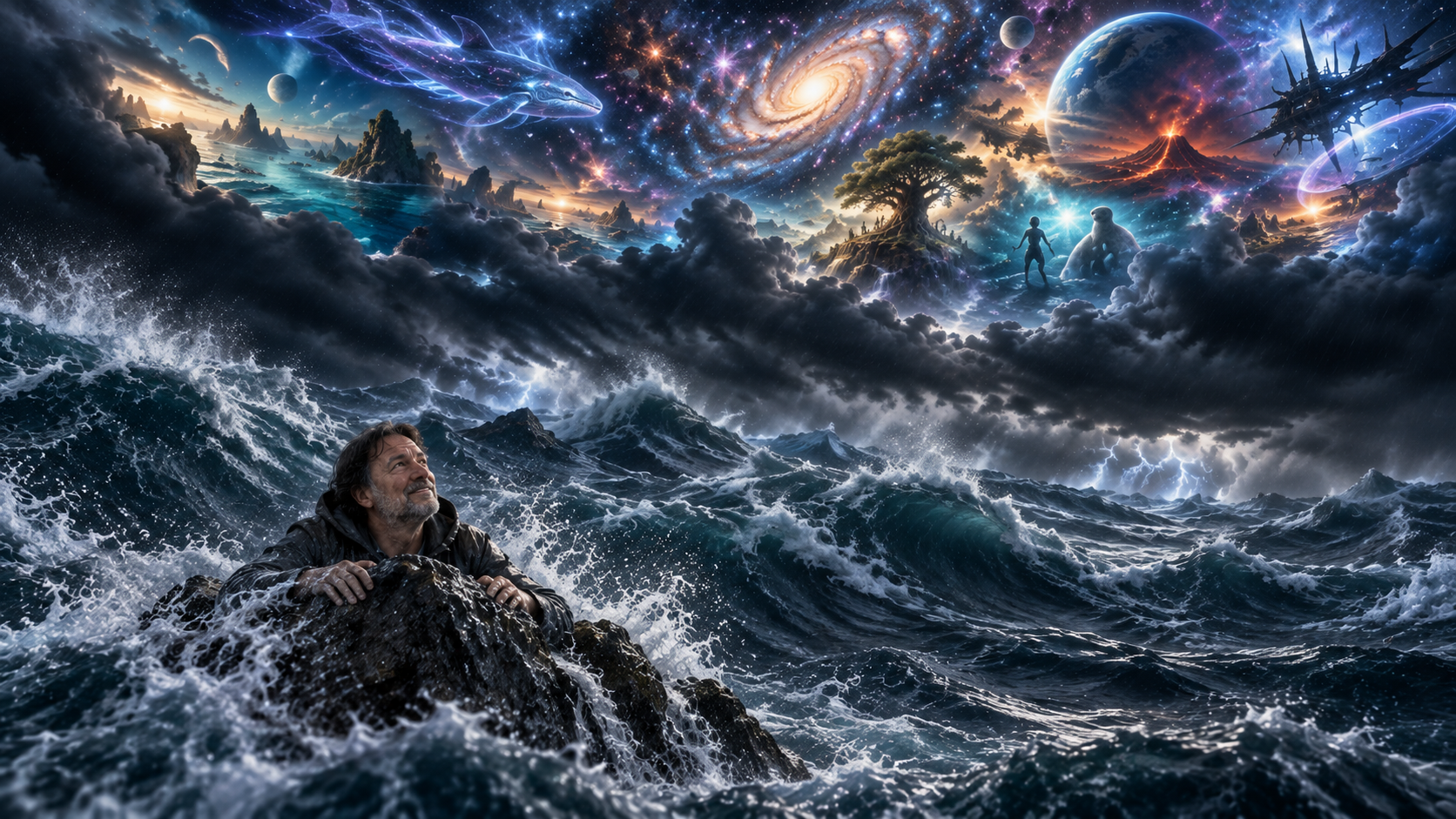
Then I dreamed about a wave.
It was not a wave on Earth but on another planet, an ocean world where two moons pulled against the sea and created tides unlike anything a human surfer had ever experienced. Around that time, I had been reading about the possibility of ancient oceans on Mars and thinking about how gravity influences waves. I began wondering what waves might look like on a smaller planet with lower gravity and, being a surfer, the next question was inevitable: what would it be like to surf them?

That simple question eventually became Songs of Thalassa, then Fires of Hina, and finally The Spiritual Engineers. Looking back now, as I finish the trilogy, I can see a path that was invisible when I started. What began as a story about surfing enormous waves on another planet gradually became something much larger: a reflection on our relationship with nature, our separation from it, and ultimately what it means to be human. Along the way, the books changed as my thinking changed, and somewhat unexpectedly, writing them changed me as well.
When Science Wasn’t Enough
I began my career as a marine biologist because I loved the ocean. Like many young scientists, I was fascinated by how nature worked—the ecology of reefs and kelp forests, the strange organisms that lived beneath the surface, and the intricate relationships that held marine ecosystems together. Over time, however, the questions changed. I began seeing the consequences of human activities everywhere I worked. Abalone disappeared, coral reefs declined, kelp forests changed, and fisheries collapsed. What had begun as an attempt to understand nature increasingly became an effort to understand what we were doing to it, and my research gradually shifted toward conservation. I worked with scientists, fishermen, communities, government agencies, conservation organizations, and policymakers in the United States and around the world, trying to translate scientific knowledge into management and use evidence to change the machinery of society enough to protect the ecosystems upon which we depend.

I still believe deeply in that work. Science is essential because without it we cannot understand what is happening to the natural world, distinguish evidence from opinion, or make intelligent decisions about what to do. But sometime around 2012 or so, I began feeling that something was missing. Science could tell us that an ecosystem was declining, measure that decline, identify its causes, model its future, and recommend ways to slow or reverse it, but science had a much harder time answering another question:
Why should someone care?
For scientists, the answer often seems obvious. If we present enough evidence, surely people will understand, and if they understand, surely they will act. My experience suggested otherwise because facts enter a world already inhabited by values, histories, identities, fears, desires, cultures, and deeply embedded ideas about who we are. Science can inform those beliefs, but it rarely replaces them. Increasingly, I came to think that science was necessary, but not sufficient, and I began looking for another way.
From Science to Science Fiction
In 2013, I started blogging. Initially, I wrote mostly about science and conservation, but gradually I wandered into subjects that had fascinated me for much of my life: astronomy, space exploration, human evolution, philosophy, surfing, spirituality, and science fiction. I had grown up reading Isaac Asimov, Frank Herbert, Larry Niven, Jerry Pournelle, Ursula K. Le Guin, H. G. Wells and others, while Tolkien was another enormous influence even though his worlds emerged more from mythology than science. What fascinated me about these writers was not simply their ability to imagine strange planets, technologies, or creatures, but their ability to remove us from the familiar world long enough to make us look at ourselves differently.

That, I began to realize, is one of the great powers of speculative fiction. If I tell someone that humanity is destroying an ecosystem, the statement immediately enters the tangled landscape of contemporary politics, economics, culture, and personal belief. But suppose I take the same problem and move it twelve light-years away, where there are no countries we recognize, no familiar political parties, and none of our historical grievances. There is only an ocean planet filled with life—and humans arriving for the first time. What would we do? Suddenly an old question can become new again. That realization coincided with my growing interest in astronomy and astrobiology, my lifelong fascination with the ocean, and my awe of very large waves. Those threads eventually converged on Thalassa.
A World That Sang
The original idea was relatively simple: imagine a pristine ocean planet where blue water stretches across most of the surface, life has evolved for billions of years without human interference, its ecosystems remain intact, and the gravitational interactions of its moons periodically generate waves far larger than anything on Earth. Then send a surfer there. More importantly, send someone who does not arrive intending to save the planet. That person became Sage Thompson, and I wanted her transformation to arise from encounter rather than ideology. She would go to Thalassa for her own reasons and discover something she had never expected—a world that was not merely beautiful but alive in ways she did not understand. The deeper question became:
What happens when a human being encounters a world that has never been broken by humans?

Would we recognize what we were seeing and fall in love with it, or would we calculate its value? Would we see an extraordinary living world or an extraordinary collection of resources? The question was hardly limited to another planet because we have been making versions of that choice on Earth for thousands of years. I made Sage Hawaiian because I wanted another way of understanding nature to run through the story. Indigenous Hawaiian and other Polynesian traditions contain relationships with land and ocean that differ in important ways from the industrial worldview that came to dominate much of modern society. I did not want to romanticize Indigenous cultures or suggest that people in the past lived in some ecological paradise, but many Indigenous traditions preserve something I believe modern society desperately needs: an understanding that humans exist within nature rather than outside it.
For most of human history, that truth was impossible to forget. Water did not come from a faucet, food did not originate in a supermarket, and weather was not something experienced primarily through an app. Survival required attention to seasons, animals, plants, currents, rainfall, soil, and stars. Modern civilization has insulated many of us from those relationships so successfully that we can begin to imagine they no longer exist. Animals become commodities, water becomes a resource, forests become timber, oceans become fisheries, and air becomes something so ubiquitous that we scarcely think about it until it becomes polluted.
Yet beneath all our technology, the old relationships remain. We still breathe an atmosphere maintained by living processes, drink water cycling through the planet, and depend upon soil, oceans, plants, microorganisms, and other species for our existence. We have not transcended nature. We have simply become very good at forgetting that we are part of it, and I increasingly came to believe that our disconnection from the natural world was related to the ways we had become disconnected from one another
The Walking Whales
As Songs of Thalassa developed, I realized the planet needed something readers could connect with emotionally. It needed charismatic marine animals, and whales seemed obvious—but perhaps too obvious. Putting something resembling a humpback whale on an alien ocean planet felt too trite, so I began looking backward through cetacean evolution. Roughly fifty million years ago, the ancestors of modern whales were undergoing one of the most remarkable transitions in evolutionary history as mammals that had lived on land moved increasingly into the water. Some of these early cetaceans could still walk while also swimming effectively, and these so-called walking whales fascinated me. From them eventually came the Nesoi, animals that could move between land and sea and were mammalian enough to evoke recognition while remaining alien enough to retain their mystery.

The more I wrote about them, however, the more interesting they became. Their songs mattered, their behavior mattered, and their relationship with Sage became increasingly central to the story. Gradually they ceased being charismatic furry creatures inhabiting the background of Thalassa and became one of the central threads of the novel. This also created a rather serious problem for the scientist writing it: what was something resembling a fifty-million-year-old ancestor of Earth’s whales doing on a planet twelve light-years away? I didn’t know. At first, I simply left the question hanging, but that unanswered question would eventually become one of the seeds of the entire Songs of the Universe trilogy.
How One Book Became Three
When I was finishing Songs of Thalassa, some of my early readers pointed out that I was trying to explain too much. I didn’t need to answer every question in the first novel, they told me; some mysteries could remain mysteries and perhaps be explored later. Then, while preparing to publish Songs of Thalassa in 2019, I hired Smith Publicity, and they suggested that I consider making the book part of a trilogy. Readers liked series, they said, and three connected books could create opportunities that a single novel might not. It seemed reasonable enough. Rather like Frodo agreeing to take the Ring to Mordor without fully appreciating the itinerary, I thought: sure, why not? Ten years after beginning this journey, I now have a much better understanding of what “why not?” can entail, but it was also one of the best decisions I made because once I allowed the story to continue, the questions became much larger.
From Sage to Lani to Rigel
Songs of Thalassa is fundamentally a story of encounter. Sage travels from Earth to another world and encounters Thalassa, the Nesoi, and eventually a different way of understanding her relationship with the life around her. The movement is outward, from the familiar toward the unknown. Fires of Hina begins ten years later and shifts the story to Sage’s younger cousin, Lani. Thalassa has been protected, but Earth’s environmental condition has continued to deteriorate. When the planet is reopened, corporations return and see what humans have often seen in new lands throughout our history: opportunity, resources, wealth, and something to possess. Lani goes to Thalassa to protect it, but the story gradually expands beyond conservation as she discovers that the Nesoi are not the primitive animals humans assumed them to be. Their songs contain meaning, they use symbols, their history reaches beyond Thalassa, and their songs appear to connect across enormous distances—with cetaceans on Earth, with human wayfinders, and perhaps with something much older. The question that began with a walking whale therefore became something much larger:
What connects life across worlds?

That question led to The Spiritual Engineers. Lani’s son Rigel is born on Thalassa at the end of Fires of Hina. He is human, but he is raised among the Nesoi, so Earth is part of his ancestry rather than his experience. He knows humanity through stories, history, and his parents, but he does not really know what it means to be human. He also knows that the mysteries surrounding the Nesoi extend beyond Thalassa. There are symbols, artifacts, songs, and evidence that someone came before, beings his father calls the Engineers, so Rigel sets out to find them. What begins as a journey across the galaxy gradually becomes a journey into himself as he encounters other species and civilizations, each of which has found its own way of surviving and its own partial understanding of existence. Some are beautiful, some terrifying, but none possess the entire truth—and neither does Rigel.
Raised among the Nesoi, Rigel admires their harmony and their relationship with the living world. When he looks at human history, however, he sees war, exploitation, cruelty, and destruction, and part of him wants to reject that inheritance—to carve the darkness out of himself and retain only what he considers good. Eventually he learns that he cannot. To become whole, he must accept the contradiction of being human, which does not mean accepting violence or destruction as inevitable, but recognizing that our capacity for darkness exists beside our capacity for compassion, creativity, sacrifice, love, and wonder. We do not become better by pretending one half does not exist. We become better through the choices we make about which parts of ourselves we cultivate.
Eventually, Rigel goes to Earth, and only after writing much of The Spiritual Engineers did I fully appreciate how neatly that completed the circle. Songs of Thalassa begins with a human from Earth traveling to a pristine alien planet and encountering an unfamiliar species. The Spiritual Engineers reverses that journey with a human raised on that alien planet traveling to Earth and encountering us. Earth has become the alien world, and Rigel has to decide what he thinks of it.
Somewhere Between Sleeping and Waking
People sometimes ask where writers get their ideas, and I still don’t have a very good answer because many of mine arrive while I am asleep—or, more precisely, in the strange territory between sleeping and waking. I will wake during the night with some unresolved question from the book in my mind, then begin drifting back toward sleep without becoming completely unconscious. Logic loosens, connections appear that I might dismiss while fully awake, and sometimes an answer arrives. In the morning, I write it down, and a surprising amount of the trilogy emerged in this way.
That might make my writing process sound entirely intuitive, but it isn’t. I outline extensively and think about chapters, characters, backstories, beat sheets, and structure. Especially as the trilogy became more complicated, I needed to understand how events separated by hundreds of pages connected with one another. Then I start writing, and the story often carries me beyond the outline. Characters do something unexpected, a minor idea becomes important, something I thought would require five chapters suddenly needs one, while a scene I barely considered opens an entirely new direction. Chapters disappear, new ones appear, and sometimes very large sections of the book are discarded. Over time, I have come to think of structure and intuition not as opposing approaches but as parts of the same process: the structure gives me somewhere to begin, while intuition allows the story to become something I could not have completely planned in advance.
Learning to Throw Things Away
One of the hardest things writing has taught me is that the amount of work invested in something has almost nothing to do with whether it belongs in the final book. I learned that repeatedly with Songs of Thalassa. I wrote a draft, discarded roughly a third of it, rewrote it, and later discarded enormous portions again. Fires of Hina was even more difficult. I worked on it for about four years, went through six drafts, and finally reached the point where I thought I had finished the novel. Then I sent it to readers I trusted, and their response, in essence, was that it was okay—but it wasn’t great.
There are moments in writing when you can defend what you have created or listen to what the story is telling you. I threw the book away. Not the idea, the characters, or everything I had learned, but the manuscript itself, and then I started again. It was painful, but the resulting Fires of Hina was a much better book (in my opinion). More importantly, the experience taught me something I carried into The Spiritual Engineers: writing is not about protecting the words I have already written simply because they cost me time. It is about finding the story those words are trying to become. By the third book, I trusted that process much more, and perhaps more importantly, I had finally learned to trust myself.
From Scientific Writing to Fiction
In some ways, spending decades writing as a scientist was excellent preparation for science fiction. It taught me discipline, research, skepticism, and the importance of understanding that the natural world is usually more complicated than our explanations of it. In other ways, I had to unlearn almost everything. Scientific writing deliberately removes the writer. Emotion is restrained, ambiguity minimized, and claims carefully supported, qualified, and bounded by evidence. Fiction asks something almost opposite. You have to step inside another consciousness, smell the ocean, feel the cold, experience fear, love someone who doesn’t exist, and stand beneath a sky containing two moons and, for a moment, believe they are actually there.
That did not come naturally to me, and my writing changed enormously across the three novels because I changed. Gradually, I became less afraid of emotion, ambiguity, symbolism, spirituality, and questions science cannot easily answer. I did not abandon science, nor did I become less committed to evidence and reason. I simply stopped asking science to do everything. There are questions about meaning, connection, consciousness, and our place in the universe that science can illuminate without necessarily resolving, and fiction gave me a place where I could explore those questions without pretending that I already knew the answers.
Writing While Being Rebuilt
There was another journey occurring during these same ten years. As I approached retirement, I underwent two hip surgeries. Later, I lost my kidney and spent two years on dialysis while finishing Songs of Thalassa. Eventually (thanks to my son and an exchange with anonymous donor) I received a kidney transplant while working on Fires of Hina. I don’t want to turn those experiences into a convenient metaphor because illness is illness, and anyone who has lived through serious medical problems knows there is nothing particularly poetic about much of it. Yet looking backward, it is impossible not to see the two journeys beside one another. During a period when my own body was failing, being repaired, and adapting to something new, I was repeatedly dismantling and rebuilding these books.

There were many times when continuing would have been easier not to do, but writing also gave me something to focus on—a place to put my mind when so much else in my life was uncertain and beyond my control. The worlds and characters I was creating gave me somewhere else to go and something meaningful to keep moving toward. Perhaps that is another thing writing taught me. Persistence is not always heroic. Most of the time it is remarkably ordinary. You get up in the morning, sit down, and write another paragraph. You discover that the chapter doesn’t work, so you rewrite it. Sometimes you discover that the entire book doesn’t work, so you begin again. Eventually those paragraphs become chapters, the chapters become books, and somehow ten years have passed.
What Matters After Ten Years
I self-publish my books, in part because I value the creative freedom it gives me. I can revise them, design their covers, create illustrations, and think about each book as a complete creative work rather than simply a manuscript. I have not sold hundreds of thousands of copies; I have sold hundreds. Naturally, I would like more people to read them because every writer wants readers, but I am retired and my livelihood does not depend upon becoming a successful novelist. That gives me a luxury many writers do not have: I can ask a different question.
Not How many books did I sell? but, Was it worth writing them?
After ten years, the answer to that question is easy. Yes. Writing these books taught me to trust ideas I could not yet explain, to understand that imagination and evidence are not enemies, and to accept that sometimes you have to abandon years of work to discover what you were actually trying to say. Most of all, it taught me that reaching one person matters. A scientific paper can influence management, a law can protect a place, and a marine reserve can allow an ecosystem to recover. Those things matter enormously, and I remain proud of the work I did as a scientist. But stories operate somewhere else. They enter the imagination, connect ideas with emotions and experiences, and sometimes remain there long after the facts that inspired them have faded from memory.
Writing them requires a certain faith that change is possible when an idea is given the opportunity to take root, even if you never know where it lands or live to see what grows from it. Perhaps that is enough: to put something into the world that might cause someone, somewhere, to see themselves, another person, or the living world a little differently.
The Song I Was Trying to Hear
When I began Songs of Thalassa, I thought I was writing about an ocean planet. Then I thought I was writing about conservation. Later, I thought I was writing about our separation from nature. All of those things are true, but after ten years I think the trilogy is ultimately about connection. We are connected to oceans we may never see, microorganisms we will never know exist, people we will never meet, ancestors whose names have been forgotten, and generations who have not yet been born. Every breath reminds us that the boundary between ourselves and the living world is much less distinct than we like to imagine. Perhaps our greatest problem is not that we don’t understand what is happening to the Earth, but that we have forgotten that what happens to the Earth also happens to us.

That was the idea I was trying to express when Sage first heard the songs of Thalassa. It grew larger with Lani as she began discovering connections across worlds, and it became something larger still with Rigel, who traveled across the galaxy looking for answers only to discover that one of the most difficult worlds to understand was the one from which he came. Ten years ago, I thought science fiction might offer me another way to communicate ideas that thirty years of science had taught me. I wanted to write stories that might change the way someone thought about our relationship with the living world, but what I didn’t anticipate was that the first person those stories would change was me.

Perhaps that is what I hear now when I look back across the three books: a thread connecting Sage, Lani, and Rigel; Earth and Thalassa; science and spirituality; the scientist I was and the storyteller I became. I didn’t understand all of that when I started, and perhaps I couldn’t have. The story had to evolve as I did. What began with a dream about an enormous wave on a distant ocean eventually became a ten-year attempt to understand our place within something much larger than ourselves—a living planet, a universe filled with possibilities, and the complicated, contradictory experience of being human. It was a song I didn’t entirely understand when I began writing it.
I just had to keep listening.

Posts related to writing of the trilogy:
- Surfing on Mars
- Cortes Bank: the Largest Wave on the Planet
- Walking Whales and The Rise of the Cetaceans
- When Invertebrates Ruled the Planet: the Enigmatic Rangeomorphs
- The Last Song of Mother Earth and the Death of Coral Reefs
- Are Animals Conscious and Does it Matter?
- Songs of the Trees
- Do Plants Have Souls?
- The Call of Nature and the Renewal of the Nature Fast
- Eight Experiences that Honor the Forces of the Ocean
- Aim For The Moon: The Space Program That Inspired a Generation of Scientists
- Sailing Through Life’s Waves: My Second Pass Through Dialysis
- The Surfing Ecologist: A New Synergy for Surfers and Science
- Deep Impact: Five Reasons Why Surfers Should Care About Global Warming



Leave a Reply